Safety and Relief Valves Practice Questions
Safety and relief valves protect boilers and pressure vessels from overpressure. This guide covers valve types, set pressure and capacity, installation, testing, maintenance, and common faults. Samples are labelled with their source and draw from 5th, 4th, and 2nd Class exams; requirements vary with equipment and applicable code.
Study Guide: Safety and Relief Valves
Why they matter
Every boiler and pressure vessel is built for a maximum working pressure. A safety or relief valve opens automatically if pressure climbs toward that limit, and closes again once it falls. It needs no outside power or control signal, which is why it is the last reliable protection against an overpressure explosion.
Types of pressure relief valves
- Safety valve: opens rapidly ("pops") and is used mainly on steam and other compressible fluids.
- Relief valve: opens gradually as pressure rises and is used on liquids.
- Safety relief valve: can open either way and is used on liquids or gases. It is the usual choice on hot water heating boilers.
- Temperature and pressure (T&P) relief valve: responds to either high pressure or high temperature. It is used on potable hot water heaters.
Power boiler requirements (ASME Section I)
- Every boiler needs at least one valve. It needs two or more if it has more than 500 ft² (47 m²) of bare tube water-heating surface, or if it is an electric boiler with more than 1100 kW input.
- The valves together must be able to discharge all the steam the boiler can make, without pressure rising more than 6% above the highest valve setting, and never more than 6% above the maximum allowable working pressure.
- A superheater valve is set to open before the drum valves and close after them. That keeps steam flowing through the superheater so the tubes don't overheat.
- Valves are made of cast iron, steel, alloy steel, or bronze. Cast iron and bronze are for lower pressures and temperatures. Bronze parts are not allowed on superheaters operating above 230°C, and superheater and reheater valves must be steel or alloy steel.
How a safety valve works
A spring presses the disc onto the seat. When steam pressure reaches the set (popping) pressure, the disc lifts slightly and steam escapes. The disc has a lip that forms a huddling chamber. Escaping steam fills it, acts on a larger area of the disc, and pushes the valve wide open. This is the pop action. The same lip helps the valve snap shut once pressure drops.
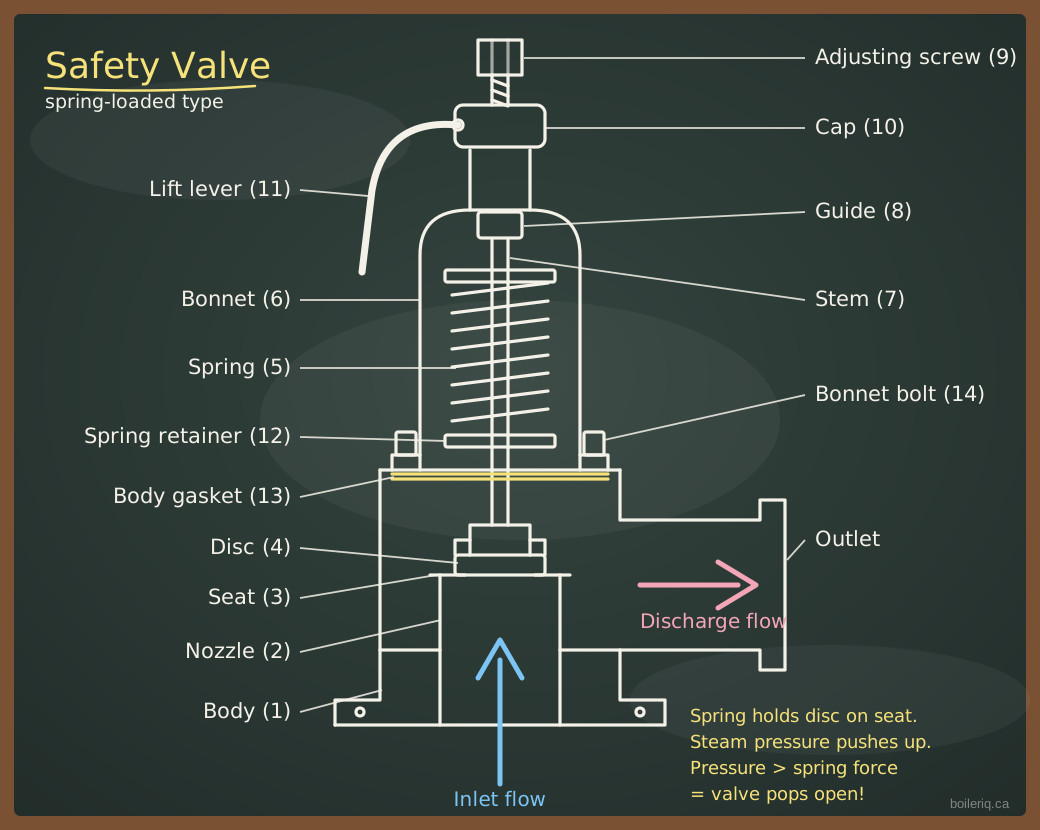
Blowdown
Blowdown is the difference between the pressure where the valve opens and the pressure where it reseats. The code sets a minimum of 2 psi (15 kPa) or 2% of set pressure. A threaded blowdown adjusting ring controls it:
- Ring blocking the huddling chamber escape ports: higher pressure under the lip, so boiler pressure must fall further before the valve closes (longer blowdown).
- Ring opening the ports: pressure under the lip drops sooner, so the valve closes with a smaller pressure drop (shorter blowdown).
The ring is locked with a screw and sealed by the Boiler Inspector.
Adjusting set pressure
The spring compression sets the popping pressure. Screwing the adjusting nut down raises it, and screwing it up lowers it. A valve can only be adjusted about 5% either way from the setting marked on it. This work must be done by the manufacturer, an authorized representative, or an assembler. Operators must never tamper with a set pressure, and doing so is illegal in all Canadian jurisdictions. After a change, the valve gets a new data tag and a new seal.
Installation rules
- Mount the valve upright with the spindle vertical.
- Connect it directly to the boiler, on its own connection, as close as possible, with no unnecessary pipe or fittings.
- Never put a shut-off valve between the boiler and the valve, or in the discharge pipe.
- The discharge pipe must be at least as large as the valve outlet. It must be short, straight, drained, and arranged so nobody can be scalded.
- Support the discharge pipe separately, with room for expansion, so it puts no force on the valve. A long vertical pipe may need a flexible joint.
- On heating boilers, mount the valve in the highest practical part of the boiler and never below the lowest permissible water level.
- Never plug the outlet of a relief valve.
Heating boilers (ASME Section IV)
- Steam heating boilers: need a spring pop safety valve set no higher than 15 psi (100 kPa). The valve size must be between NPS ½ and NPS 4. Capacity must be enough that pressure cannot rise more than 5 psi (35 kPa) above the maximum allowable working pressure.
- Low-pressure steam safety valves: are shorter and wider than high-pressure ones and have no adjustable blowdown ring.
- Hot water boilers: need at least one automatic-reseating safety relief valve set at or below the maximum allowable working pressure. These valves have no blowdown ring and no bottom guide, and the set pressure cannot be reset in the field.
- Body drain: every valve has a drain below the seat. Never plug it. It stops condensate collecting around the seat, which can cause corrosion and a stuck valve.
Why a relief valve weeps
A relief valve that opens often or leaks during normal operation means something is wrong. Common causes:
- A waterlogged expansion tank. The tank must be isolated, drained, and returned to service.
- Scale or deposits on the seat.
- A valve rated for the wrong pressure range.
- Worn seats or a weakened spring.
Testing
| Test | How often |
|---|---|
| Try lever test, steam heating boilers | Monthly |
| Try lever test, hot water heating boilers | Every 3 months |
| Try lever test, power boilers under 2760 kPa | Every 6 months |
| Pop test | Annually, before the boiler comes off line |
Try lever test: the boiler must be under pressure first. That is at least 35 kPa on steam heating boilers, and at least 75% of the valve setting on power boilers. Lift the lever fully open, let steam discharge for 5 to 10 seconds, then release it and let the spring snap the disc shut. If the valve keeps simmering, operate the lever two or three times. If it still simmers, repair or replace it. This test shows the valve moves freely. It does not show the pressure at which it opens.
Pop test: raise pressure to the set point, record the exact opening and reseating pressures, work out the blowdown, and compare the results to the code tolerances.
Repairs: done only by the manufacturer or its authorized repair representative.
Potable hot water heaters
- These heaters operate at no more than 1100 kPa and 99°C. They use safety relief valves or T&P valves.
- A T&P valve has a pressure spring and a wax-filled temperature sensor. The wax expands at about 99°C and lifts the disc, letting hot water out until the temperature falls. It does not pop open.
- T&P valves should get an annual try lever test.
- Temperature-only devices are not enough on their own. They need additional pressure relief.
- A fusible element melts at 99°C and does not reseat. A rod-and-tube device opens at 99°C and recloses at 71°C.
Quick facts for the exam
- Safety valve = rapid pop, steam. Safety relief valve = liquids, hot water boilers.
- Superheater valve opens first and closes last.
- Minimum blowdown: 2 psi (15 kPa) or 2% of set pressure.
- Set pressure adjustment limit: plus or minus 5%, manufacturer only.
- Never fit a stop valve before or after a safety valve, and never plug the outlet.
- A try lever test checks free movement, and a pop test checks the set pressure.
Watch the safety valve video
Practice questions from different classes
Choose an answer to check it and see the explanation. Each question is labelled with its source exam.
- 1
A hot water boiler relief valve discharges each time the boiler fires. What is a typical cause?
Source: 5th Class
Show answer and explanation
Answer: C. A ruptured diaphragm tank or flooded expansion tank
A ruptured diaphragm tank or flooded expansion tank leaves no room for expansion, so the relief valve typically discharges when the boiler fires.
- 2
A boiler specification sheet lists both a 'design pressure' and a 'maximum allowable working pressure' (MAWP). An engineer needs to know which value governs the setting of the safety valve. Which value is used?
Source: 4th Class 4A1
Show answer and explanation
Answer: A. The MAWP
The safety valve is set based on the maximum allowable working pressure (MAWP), which represents the highest pressure the boiler is certified to safely operate at, rather than the design pressure, which may include additional engineering margin beyond the certified operating limit.
- 3
When setting several safety valves on one steam generator, in what order are they set?
Source: 2nd Class 2A3
Show answer and explanation
Answer: D. Lowest set valve first, then each higher one is set while the lower valves are gagged
The lowest set valve is tested and set first, then gagged while the next higher valve is set, and so on until the highest valve is set last.
- 4
What happens if the blowdown ring of a pop safety valve is screwed up toward the portholes?
Source: 5th Class
Show answer and explanation
Answer: D. Escape port area decreases, the valve stays open longer, and blowdown increases
Screwing the ring up decreases port area, directing more steam against the lip. The greater lifting force keeps the valve open longer and it closes at a lower pressure, increasing blowdown.
- 5
Per ASME Code, a boiler with more than 46.4 m² (500 sq. ft.) of water heating surface must be fitted with:
Source: 4th Class 4B
Show answer and explanation
Answer: D. Two or more safety valves
ASME Code requires at least one safety valve on every steam boiler, but boilers exceeding 46.4 m² of water heating surface must have two or more safety valves to ensure adequate discharge capacity.
- 6
A hot water boiler's relief valve is set at 250 kPa. What is the highest recommended operating pressure?
Source: 5th Class
Show answer and explanation
Answer: B. 181 kPa
25% of 250 kPa is 62.5 kPa, which is less than 69 kPa. The 69 kPa minimum applies, so the maximum is 250 − 69 = 181 kPa.
- 7
What is the function of the 'huddling chamber' (pop chamber) with its adjustable outlet ports on a safety valve?
Source: 4th Class 4B
Show answer and explanation
Answer: C. It allows steam to act on an increased disc area, causing the valve to pop rapidly open and controlling the blowdown
As the valve begins to lift, steam entering the huddling chamber acts on the increased area beneath the disc's skirt, generating extra lifting force that snaps the valve fully open; the adjustable ports in this chamber also control how much pressure drop is needed before the valve recloses (the blowdown).
- 8
Before a pop test on a hot water boiler, how high may the boiler pressure be?
Source: 5th Class
Show answer and explanation
Answer: A. Not more than 50% of the relief valve set pressure
Pressure must be not more than 50% of the set pressure. Reduce excess pressure with the boiler drain, not the try lever, which would defeat the test's accuracy.
- 9
The 'blowdown' of a safety valve refers to:
Source: 4th Class 4B
Show answer and explanation
Answer: D. The difference between its opening and closing pressures
Blowdown is the pressure differential between popping (opening) pressure and reseating (closing) pressure; per ASME Section I, PG-72.1, this must be at least 14 kPa (2 psi), with the valve required to close at no lower than 96% of set pressure.
- 10
By how much can a safety valve's popping pressure be adjusted from its original spring setting, per ASME Code Section I?
Source: 4th Class 4B
Show answer and explanation
Answer: B. 5%
ASME Code Section I permits adjusting the popping pressure by up to 5% by changing spring compression, and such adjustment may only be performed with the permission of an authorized Boiler Inspector.
Choose your Power Engineering exam
Safety and relief valves appear across multiple exam levels. Browse the catalog to choose your class and find its practice questions.
Browse practice exams