Guarded Status Incident Report — Free Download
A structured incident report for Manitoba Guarded Status boiler plants. Captures incident description, immediate actions taken, root cause analysis, corrective actions, and preventive measures with full owner verification.
Download Free PDF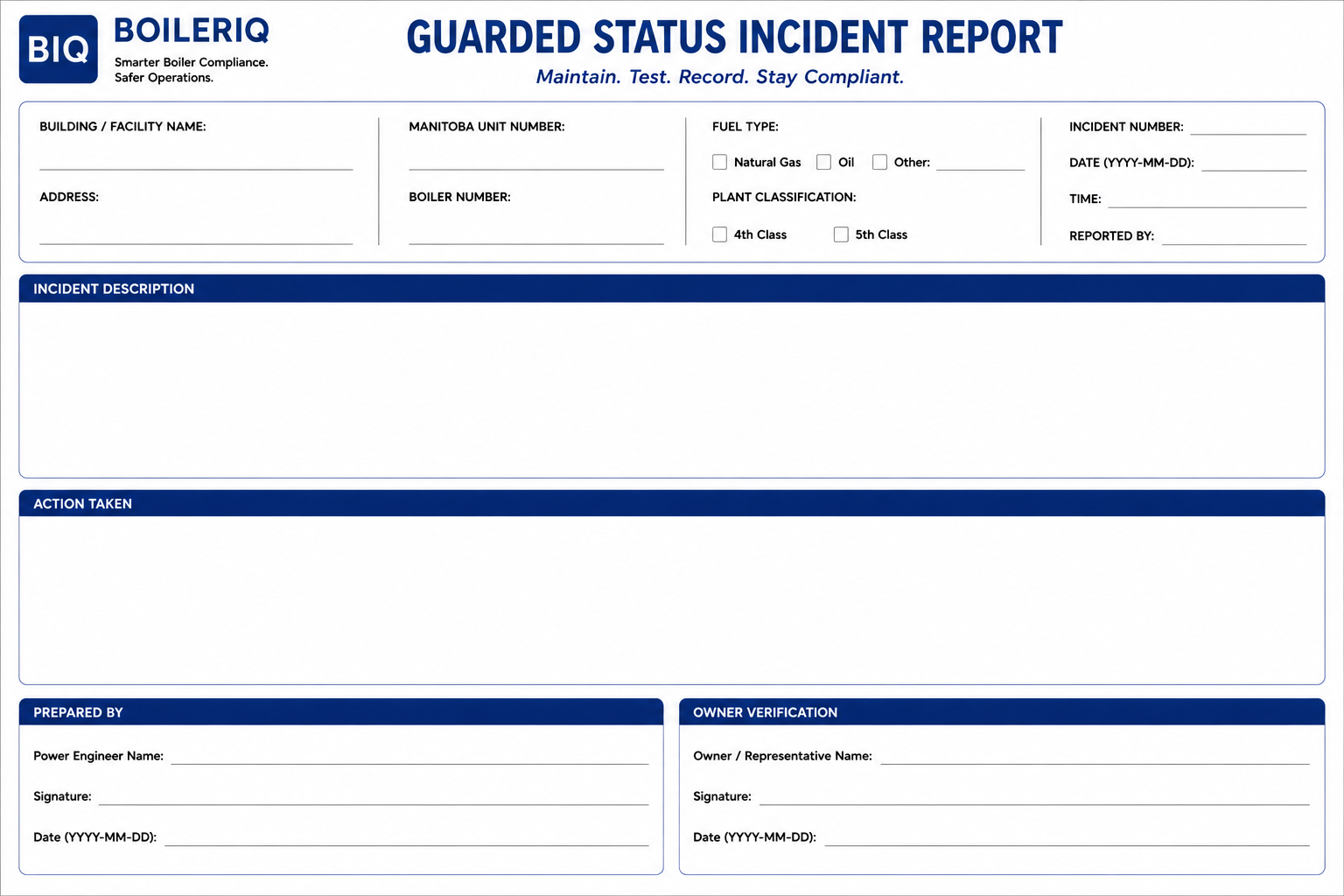
Purpose of the Guarded Status Incident Report
The Guarded Status Incident Report is a structured documentation form for recording abnormal events, safety system activations, equipment failures, and other incidents affecting the safe operation of a Manitoba boiler plant operating under Guarded Status classification. It serves as both an internal compliance record and, in cases requiring regulatory notification, a foundational document for reporting to Manitoba's Technical Safety Division.
Incident reporting is a critical component of Guarded Status compliance. When a boiler plant operates without continuous licensed operator attendance, the integrity of the safety monitoring and response systems is paramount. Any event that tests or compromises those systems — even if resolved without harm — provides important information about the plant's safety state and the effectiveness of the Guarded Status arrangement.
BoilerIQ provides two versions of the incident report. The standard form covers incident description, action taken, and basic verification. The detailed form adds structured sections for Immediate Actions Taken, Root Cause Analysis, Corrective Action (Permanent), and Preventive Measures. Facilities should use the appropriate version based on the nature and severity of the incident.
Who Uses This Form
The incident report is prepared by the Power Engineer who responds to or is first notified of the incident. The 'Prepared By' section requires the engineer's printed name, signature, and the date. The Owner Verification section requires the facility owner or authorized representative to review and sign the report, confirming that the documented information is accurate and that the described corrective actions have been or will be taken.
For significant incidents — those involving safety system failures, regulatory reporting obligations, or situations where operation was suspended — the facility manager or owner should be involved in reviewing the incident report before it is finalized. The completed report may be reviewed by Manitoba ITS, insurance inspectors, or legal counsel, so accuracy and completeness are essential.
Even for minor incidents that are fully resolved at the plant level, maintaining a complete incident log demonstrates that the facility takes its safety responsibilities seriously and has processes in place for identifying and learning from abnormal events. Facilities that cannot produce incident records when asked by a BPV Inspector may face questions about whether they are actively monitoring plant safety.
When to Complete an Incident Report
Complete an incident report as soon as practicable after an incident occurs — ideally on the same day. Delaying documentation increases the risk of inaccurate or incomplete information, particularly for incidents involving multiple steps or time-sensitive actions. A prompt report written with the events fresh in mind is always more reliable than a report completed days later from memory.
The incident report should be initiated any time the following occur: a safety device activates (low water cutoff, high pressure limit, flame failure protection, fuel valve closure); an unplanned boiler shutdown occurs; an alarm condition is triggered on the monitoring system; equipment damage or malfunction is observed; a near-miss event occurs where a safety hazard existed but did not result in injury or damage; or any situation arises that required the Power Engineer to take action beyond normal operating procedures.
Routine maintenance findings — such as noting a slightly corroded fitting during a monthly inspection — are documented on the inspection forms rather than triggering an incident report. Incident reports are reserved for events that represent an abnormal departure from expected plant operation or that required active safety response.
Completing a Thorough Incident Description
The Incident Description section is the most important part of the form. A complete incident description answers: What happened? When did it happen (date and time)? What was the plant's operating state at the time? What systems were affected? What were the observed conditions or indications? Who was present or first notified?
Write the description in plain, factual language. Avoid assumptions, speculation, or conclusions in the description section — those belong in the Root Cause Analysis section if using the detailed form. Describe what was observed directly, not what you think caused the event. For example: 'Low water cutoff activated at 14:23, shutting down boiler. Plant was in Guarded Status at time of activation. Water level in gauge glass was below minimum visible range.' This is more useful than: 'Plant shut down due to low water — probably a feedwater pump issue.'
The Building/Facility information in the header — including Manitoba Unit Number, Boiler Number, Fuel Type, Plant Classification, Incident Number, Date, Time, and Reported By — should all be completed before describing the incident. Assign incident numbers sequentially so your records can be referenced easily.
Compliance Considerations for Manitoba Facilities
Incident documentation serves a dual purpose: it demonstrates active safety management, and it creates a record that supports regulatory compliance. Manitoba's Technical Safety Act imposes reporting requirements on facilities when certain categories of incidents occur. Maintaining your own internal incident reports ensures you have accurate records available if a regulatory notification is required.
Guarded Status facilities face heightened scrutiny with respect to incidents because the reduced supervision arrangement is premised on the effectiveness of safety systems. An incident that reveals a deficiency in a safety system — even a deficiency that was promptly corrected — may prompt Manitoba ITS to assess whether the facility's Guarded Status conditions remain appropriate.
When a significant incident occurs, document not only what happened but also the timeline of detection and response. How quickly was the incident detected? What monitoring system provided the alert? How quickly did the Power Engineer respond? What actions were taken, and in what order? This timeline demonstrates whether the facility's Guarded Status safety architecture performed as intended and whether the response was timely and appropriate.
How to Download and Use This Form
Download the BoilerIQ Guarded Status Incident Report using the button on this page. Both the standard and detailed versions are available. Print several copies and store them in the boiler room as part of your emergency and compliance documentation kit. Having blank incident report forms immediately accessible ensures that documentation can begin promptly when an incident occurs.
Complete the header section first: Building/Facility Name, Address, Manitoba Unit Number, Boiler Number, Fuel Type, Plant Classification, Incident Number, Date, Time, and Reported By. Then complete the incident description while the details are fresh. If using the detailed form, work through each structured section — Immediate Actions Taken, Root Cause Analysis, Corrective Action (Permanent), and Preventive Measures — systematically.
Obtain both the Power Engineer signature and the Owner/Representative verification before filing the report. Retain incident reports permanently as part of your boiler plant compliance history. File them chronologically and note significant incidents in your compliance summary log for easy reference during regulatory reviews.
Frequently Asked Questions
Incident Report
Free PDF download — no email required.
Download Free PDFRelated Forms
Need Compliance Help?
BoilerIQ provides on-site Guarded Status assessments and inspection readiness checks for Manitoba facilities.
Contact BoilerIQ