Guarded Status Annual Inspection & Test Record — Free Download
A comprehensive annual inspection and test record for Manitoba Guarded Status boiler plants. Documents 14 inspection items including safety device testing, combustion analysis, interlock testing, and operator training verification.
Download Free PDF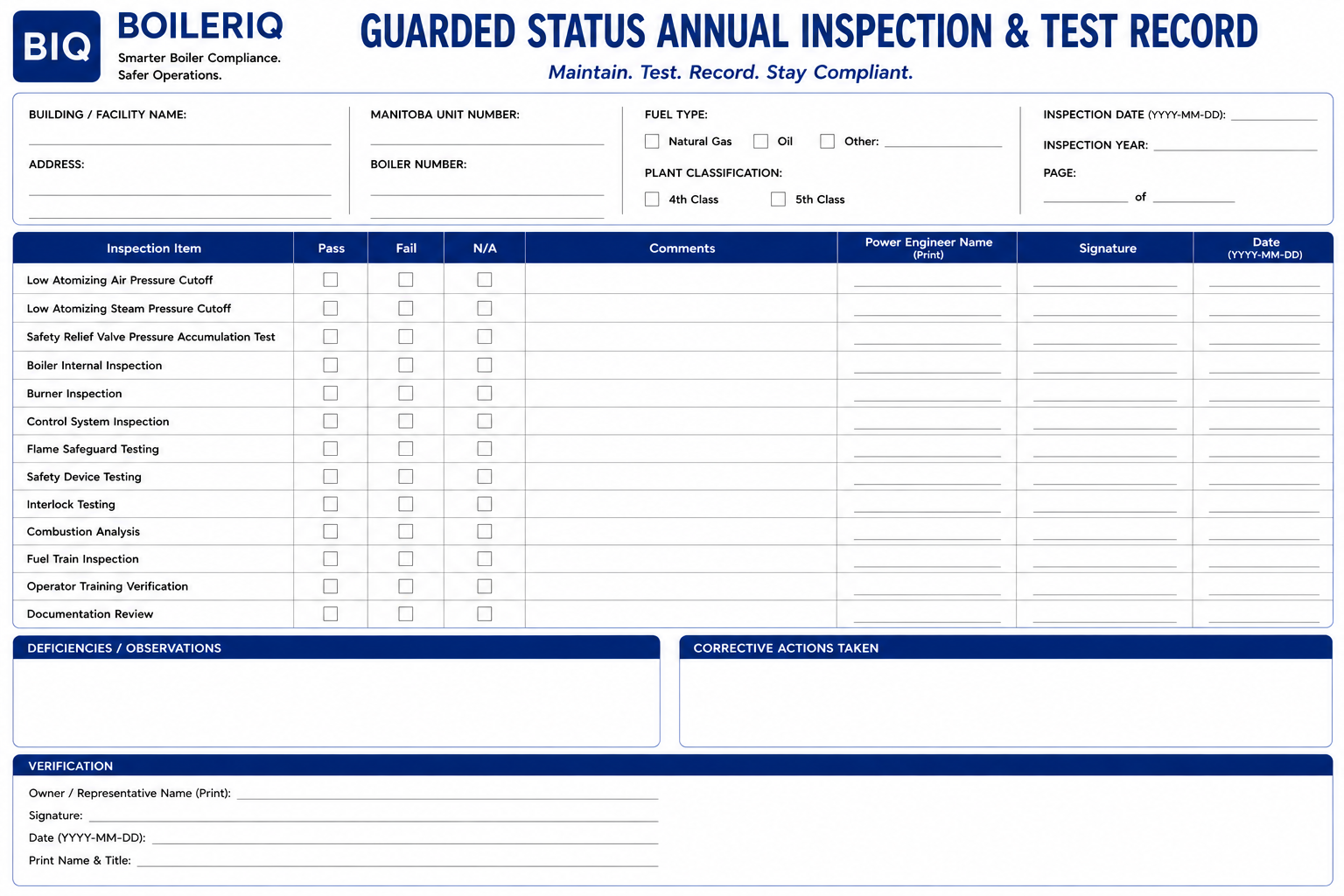
Purpose of the Annual Inspection & Test Record
The Guarded Status Annual Inspection & Test Record is a comprehensive documentation tool covering the full scope of annual compliance verification for Manitoba boiler plants operating under Guarded Status. While daily and monthly records document routine operational checks and recurring safety tests, the annual inspection record addresses the deeper, more thorough assessment that the regulatory framework requires on a yearly basis.
Annual inspections for Guarded Status plants serve two purposes. First, they provide evidence that the facility has conducted the level of review appropriate for a plant operating without continuous licensed operator attendance. Second, they create a documented baseline against which future inspections can be compared, helping to identify trends, recurring issues, or areas of gradual deterioration that might not be apparent from routine checks alone.
The BoilerIQ Annual Inspection & Test Record covers fourteen inspection items organized to flow through the major systems of the boiler plant: pressure and safety devices, combustion and burner systems, control and interlock systems, internal condition, fuel train, operational competency, and documentation integrity. The form uses a Pass/Fail/N/A structure with space for comments on each item, deficiency notes, corrective actions taken, and owner/representative verification.
Who Uses This Form
The annual inspection record is completed by the qualified Power Engineer or inspector conducting the annual assessment. For some items — such as the boiler internal inspection — a certified boiler inspector may be required in addition to or instead of the facility's Power Engineer. Facilities should review Manitoba ITS requirements for each inspection component to confirm the appropriate qualifications.
The facility owner or authorized representative signs the Verification section at the bottom of the form, confirming that the inspection has been conducted and that the findings and any corrective actions are accurate. This signature creates accountability for the completeness of the record.
Facility managers should schedule the annual inspection before the start of the heating season, or at a time when the plant can be taken offline for internal inspection if required. Leaving the annual inspection until after the heating season is underway creates operational risk and limits the ability to address findings before the plant's peak demand period.
The 14 Inspection Items Explained
Low Atomizing Air Pressure Cutoff and Low Atomizing Steam Pressure Cutoff verify that the safety cutoffs preventing burner operation under inadequate atomizing conditions are functional and set correctly for the plant's operating parameters.
The Safety Relief Valve Pressure Accumulation Test confirms that the safety relief valve activates at the correct set pressure and that the valve's capacity is adequate for the boiler's output. This test is critical — an improperly functioning safety relief valve is one of the most serious safety risks in any steam boiler plant.
Boiler Internal Inspection examines the vessel interior for signs of corrosion, scaling, cracking, or other conditions that could affect structural integrity or heat transfer efficiency. This inspection typically requires the boiler to be cool and depressurized.
Burner Inspection and Control System Inspection verify the condition and function of the combustion system and its associated controls. Flame Safeguard Testing confirms that the flame detection and burner management system will shut down the burner correctly on flame failure. Safety Device Testing covers the range of additional protective devices installed on the plant. Interlock Testing verifies that the electrical and mechanical interlocks preventing unsafe operating conditions are functional.
Combustion Analysis measures the efficiency and emissions characteristics of the combustion process, providing both an efficiency baseline and evidence that the burner is operating within acceptable parameters. Fuel Train Inspection examines the gas or oil supply components — valves, regulators, filters, and piping — for leaks, condition, and correct function.
Operator Training Verification confirms that the Power Engineer responsible for the plant holds current, appropriate certification and that their qualifications are documented. Documentation Review assesses the completeness and currency of the plant's records, procedures, and compliance documentation.
Compliance Considerations for Manitoba Facilities
The annual inspection record ties together the full scope of Guarded Status compliance documentation. A facility that has maintained thorough daily check sheets and monthly inspection records throughout the year but has not conducted a formal annual inspection has a gap in its compliance record that will be visible to any reviewing inspector.
When deficiencies are identified during the annual inspection, the documentation of corrective action is as important as the repair or remediation itself. The Corrective Actions Taken section of the form should describe specifically what was done, by whom, and when. Vague entries such as 'repaired' or 'fixed' do not adequately document the corrective action.
Manitoba facilities should be aware that Guarded Status is subject to periodic review by the Technical Safety Division. The annual inspection record, together with daily and monthly documentation, forms the evidentiary basis for a facility's claim that it is maintaining its Guarded Status obligations. Gaps, deficiencies without documented corrective action, or records that appear incomplete can trigger more frequent regulatory review.
For facilities that have experienced ownership changes, equipment modifications, or operational changes during the year, the annual inspection is an opportunity to formally assess the impact of those changes on compliance status. Any changes should be noted in the relevant comment fields and in the Documentation Review section.
Record Keeping Best Practices
The Annual Inspection & Test Record should be retained permanently as part of the facility's boiler plant history. Unlike daily and monthly records, which document routine operations, the annual record captures the formal compliance state of the plant each year and is a primary reference document for any future regulatory review, insurance assessment, or ownership transition.
File completed annual inspection records together in a dedicated binder or folder, organized chronologically. Each year's record should include the inspection date, the name of the Power Engineer or inspector who conducted the assessment, and the owner/representative signature. Incomplete verification sections raise questions about the record's authenticity.
Consider maintaining a simple summary log alongside your annual records — a one-page document listing each year's inspection date, inspector name, and any significant findings. This summary provides an at-a-glance compliance history that is useful for management reporting and simplifies preparation for regulatory reviews.
How to Download and Use This Form
Download the BoilerIQ Guarded Status Annual Inspection & Test Record using the button on this page. The form prints in landscape orientation on standard letter-size paper. Plan the annual inspection in advance, ensuring that all necessary resources — including boiler shutdown time if an internal inspection is required — are scheduled and confirmed.
Complete the header section before beginning the inspection: Building/Facility Name, Address, Manitoba Unit Number, Boiler Number, Fuel Type, Plant Classification (4th or 5th Class), Inspection Date, Inspection Year, and Page Number. Work through each inspection item systematically, recording Pass, Fail, or N/A and adding relevant comments as you go.
Complete the Deficiencies/Observations and Corrective Actions sections before filing the record. The Owner/Representative Verification section should be signed on the day the inspection is completed or, if corrective actions are required, once those actions have been documented. File the completed form with the year's compliance records.
Frequently Asked Questions
Annual Inspection Record
Free PDF download — no email required.
Download Free PDFRelated Forms
Need Compliance Help?
BoilerIQ provides on-site Guarded Status assessments and inspection readiness checks for Manitoba facilities.
Contact BoilerIQ